Beyond Interpretation: Teaching Coaches How to Think with Trait EI Data
Effective trait EI coaching goes beyond score interpretation. By treating TEIQue profiles as psychological configurations rather than checklists, coaches can ask better questions and support deeper, context-aware insight.
10 minute read
11/01/2026
Konstantinos Petrides
Imagine two experienced coaches working with the same TEIQue profile. Both are well familiar with the instrument. Both can accurately describe the client's facet scores and global trait emotional intelligence level. Yet their coaching conversations unfold in strikingly different ways. One emphasises scores, percentile ranks, and apparent strengths or weaknesses. The other pauses, asks different questions and frames the profile as a configuration that must be understood before it can be used. The difference between them is not technical competence. It is interpretive expertise.
This distinction is increasingly important in contemporary coaching psychology. As assessment tools become more refined, the limiting factor in effective practice is no longer access to data (although high-quality psychological data are increasingly scarce) but the coach's capacity to reason psychologically (as distinct from algorithmically) with that data. True expertise lies in interpretation beyond score literacy.
A Hidden Skill in Trait EI Coaching
Trait emotional intelligence theory has always resisted simplistic interpretations. From its inception, it has emphasised that no score is inherently adaptive or maladaptive, and that context, role demands, and individual circumstances determine whether a trait configuration supports or undermines functioning. In practice, however, even sophisticated coaches can drift toward mechanistic interpretation. Facet scores are treated as self-contained facts. High scores are subtly celebrated, low scores implicitly framed as development needs. Interpretation stoops to an act of translation in lieu of understanding.
Psychological literacy is something different. It refers to the ability to think with psychological data rather than merely about it. Psychologically literate coaches ask questions about patterns, combinations, and meanings, whether manifest or latent. They are comfortable with ambiguity and resist premature conclusions. They recognise that interpretation is an inferential process, not a reporting exercise.
The TEIQue Coaching Aid Report has been designed precisely to support this mode of thinking.
Why More Data Does Not Automatically Mean More Insight
One of the paradoxes of modern psychometrics is that increasing precision can flatten psychological insight if not handled carefully. The TEIQue provides rich and nuanced information, but richness invites over-interpretation. There may be a felt compulsion to comment on every facet or to build narratives that exceed what the data can reasonably support.
Mechanistic score interpretation often arises from good intentions. Coaches want to be thorough and precise. Yet this approach risks obscuring the psychological signal beneath a layer of descriptive noise. It can also shift the coaching relationship into an expert-led explanation of the client, away from a collaborative exploration with the client.
The TEIQue Coaching Aid Report deliberately avoids this trap. Its function is not to explain the profile, but to cultivate the coach's interpretive judgement.
The Logic of the TEIQue Coaching Aid Report
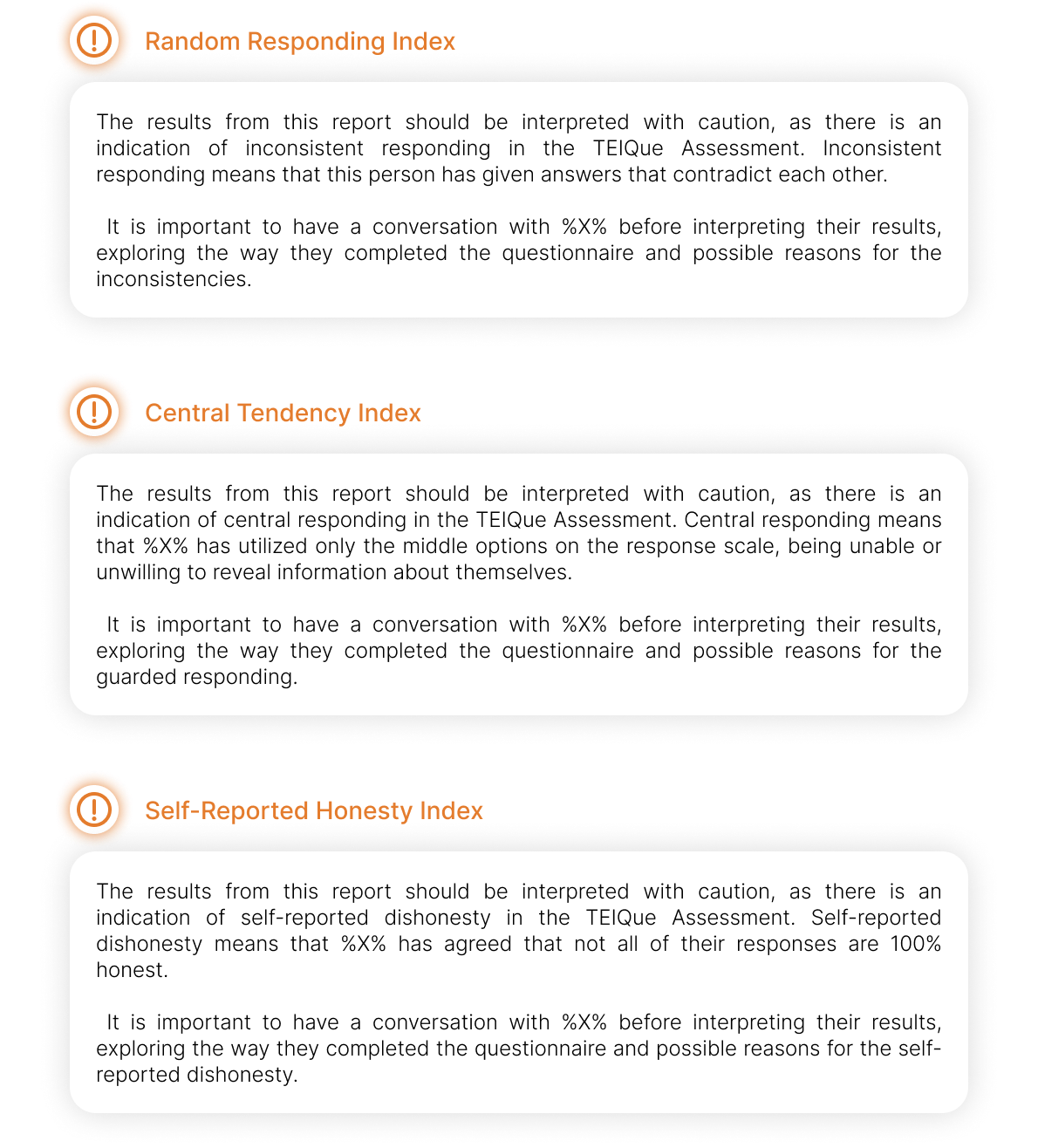
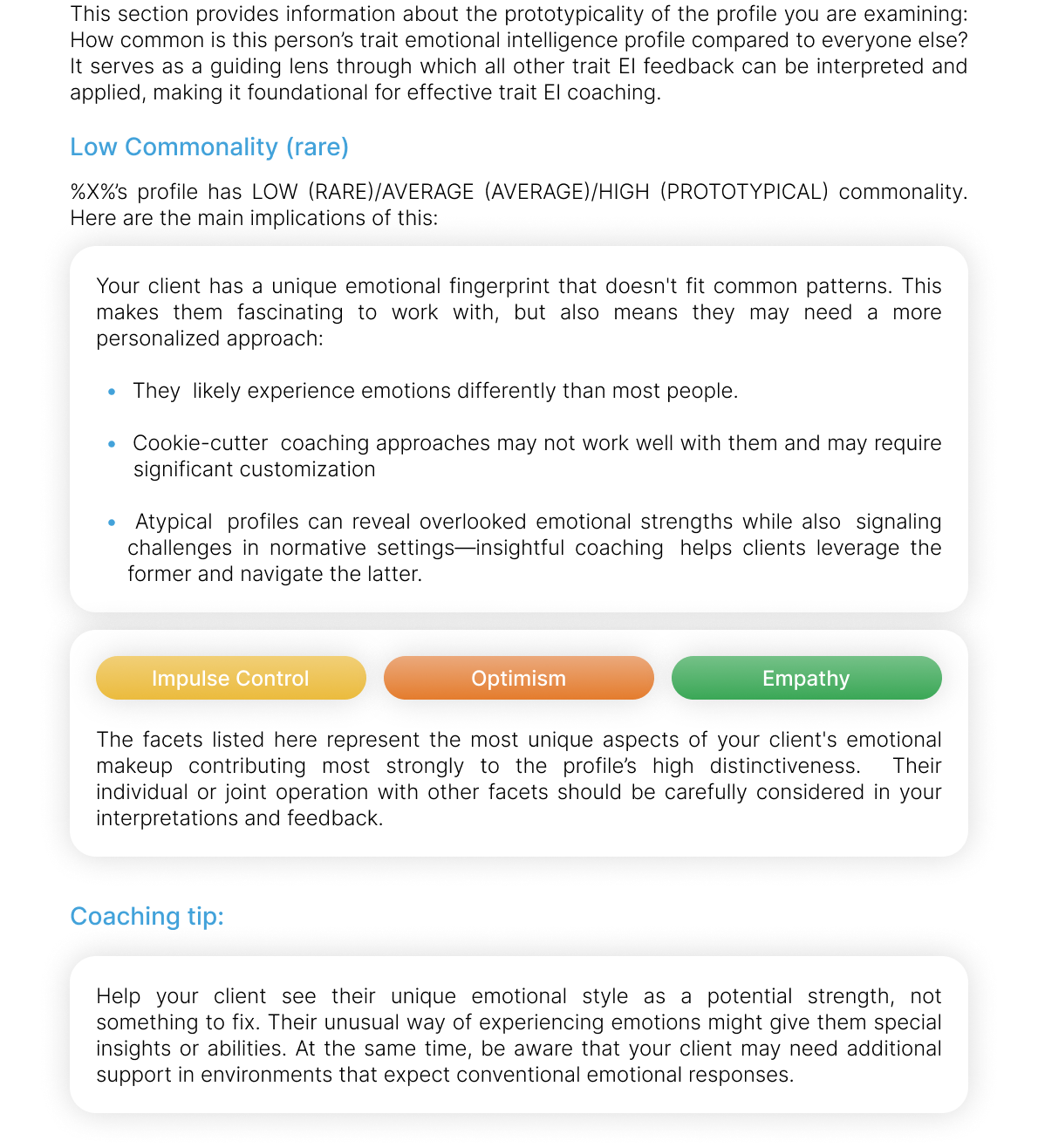
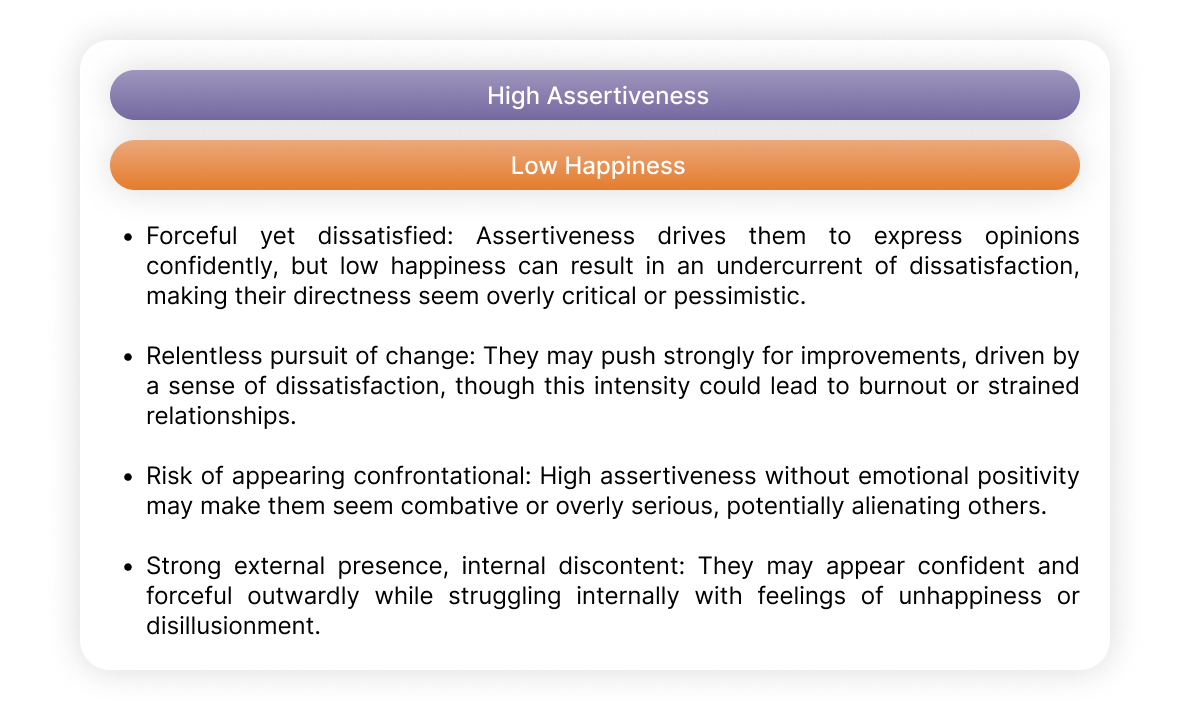
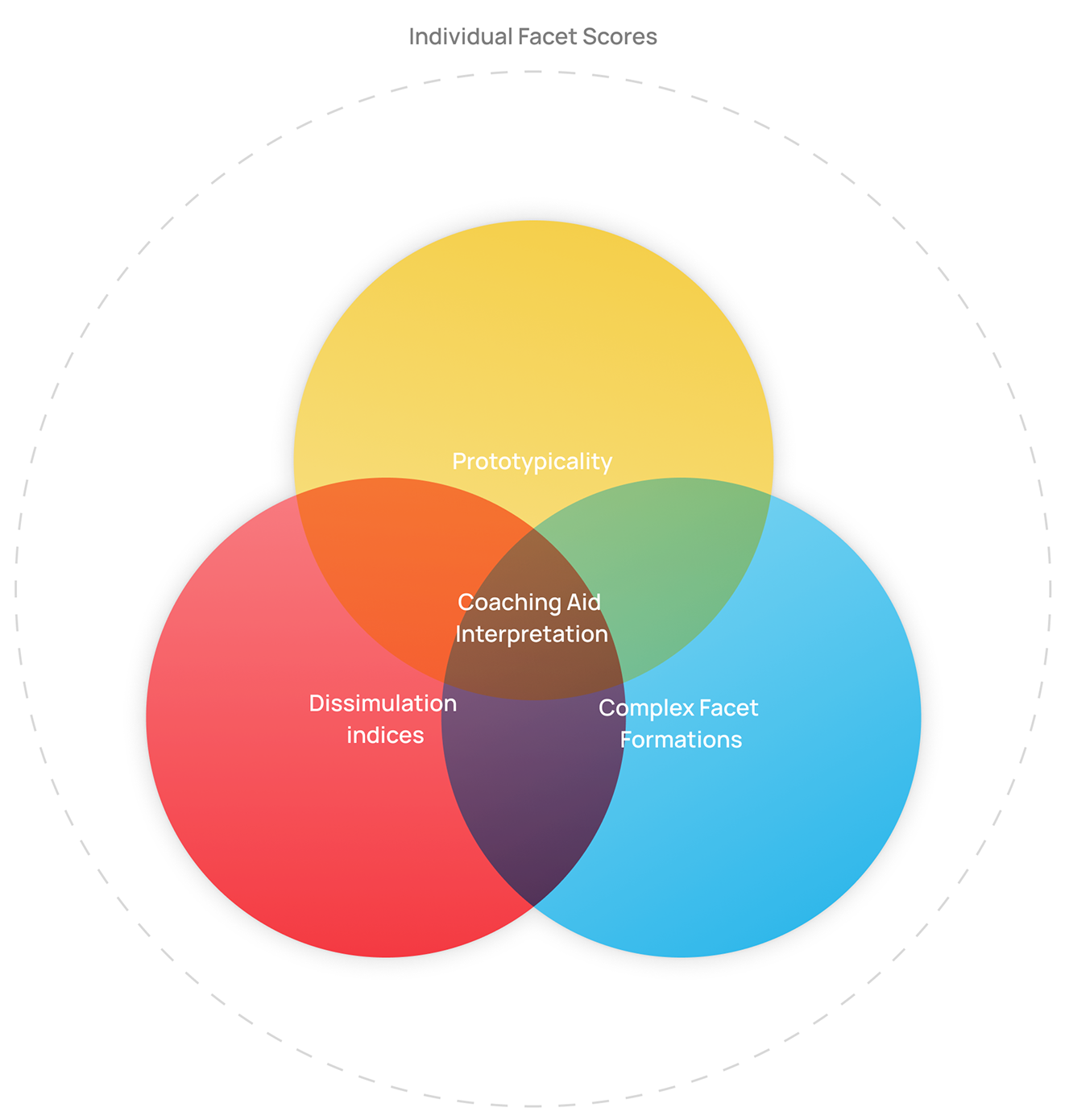
The Coaching Aid Report introduces three interpretive lenses that operate at a higher level than individual facet scores. Dissimulation indices, prototypicality, and complex facet formations do not add more traits to interpret. Instead, they change how all other information can be understood.
Effective coaching does not require more explanations. It requires better questions and intuitive framing. The report therefore positions itself as formative rather than explanatory. It can guide coaches how to think about the profile, though it stops short of dictating what to say about it.
Each of the three components addresses a different psychological question. Dissimulation indices ask how the data may have been shaped by response style and context. Prototypicality asks how common or distinctive the overall pattern is. Complex facet formations ask whether certain combinations create emergent psychological dynamics that cannot be reduced to individual traits.
Together, these lenses encourage humility and restraint, reminding coaches that interpretation is provisional, context-dependent, and always requires judgement and insight over reduction and auto-categorisation.
Developing Coaches, Not Just Better Reports
The most important output of the TEIQue Coaching Aid Report is not insight about the client. It is growth in the coach's interpretive competence. The report scaffolds a way of thinking that values vision, curiosity, and contextual sensitivity.
This is why it must remain supplementary. Used as a definitive explanation, it would undermine its own purpose. Used as a formative tool, it strengthens professional judgement and deepens psychological literacy.
Expert coaching is characterised less by self-assured certainty and more by disciplined uncertainty. It involves recognising the limits of what scores can tell us, remaining alert to context, and approaching each profile with curiosity.
Closing Reflections
Trait emotional intelligence assessment has matured considerably. A challenge now is to ensure that coaching practice matures alongside it. As tools become more precise, the interpretive demands placed on coaches increase.
The TEIQue Coaching Aid Report represents a step in this direction. It shifts attention away from score literacy and toward non-linear psychological reasoning. It contrasts mechanistic interpretation with thoughtful sense-making and positions humility, context, curiosity, and intuition as hallmarks of expertise.
Ultimately, the goal of trait EI coaching is to unlock the genuine insight that is necessary for people to understand how their emotional patterns operate in the real world. Achieving that goal requires coaches who are able to transcend simple score reporting.


.png)